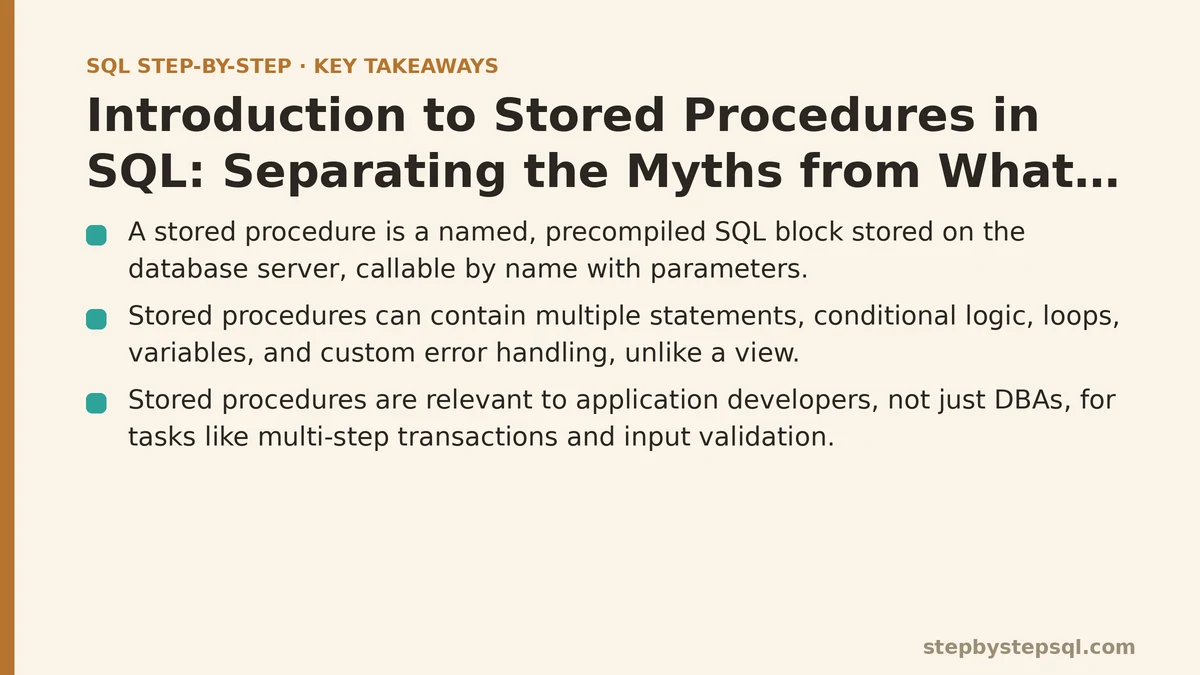
A stored procedure is a named, precompiled block of SQL statements saved inside the database itself, callable by name, and capable of accepting parameters, executing conditional logic, and returning results. It lives on the database server rather than in your application code, which means any application, script, or user with the right permissions can call it without needing to know the SQL logic contained inside.
That single-sentence definition sounds simple enough. Yet stored procedures attract more confusion, outdated advice, and flat-out myth than almost any other feature in SQL. Some of that confusion comes from decades-old debates about where business logic belongs. Some of it comes from people encountering a badly written procedure once and generalizing that experience to the entire feature. This post works through the most common misconceptions one at a time, comparing what people assume against what’s actually true.
Myth: A Stored Procedure Is Just a Saved Query
This is the most common misunderstanding, and it undersells what a stored procedure can do by a wide margin.
A saved query — a view, for instance — is a single SELECT statement given a name. A stored procedure can contain multiple statements: SELECTs, INSERTs, UPDATEs, DELETEs, all in sequence, wrapped in conditional branches using IF or CASE logic, and even looping constructs depending on the database system. It can declare local variables, check conditions before running certain statements, and raise custom errors when something goes wrong.
Reality: a stored procedure is closer to a small program than to a saved SELECT statement. It can make decisions. A view cannot.
Myth: Stored Procedures Are Only Relevant to Database Administrators
Plenty of application developers treat stored procedures as someone else’s problem — a DBA concern, disconnected from day-to-day feature work.
In practice, stored procedures show up constantly in application-facing work: encapsulating a multi-step transaction (like processing an order, which might involve checking inventory, deducting stock, and recording the sale, all as one atomic unit), validating input before it touches a table, or exposing a controlled piece of functionality to an application layer without exposing the underlying table structure directly.
Reality: any developer writing an application that talks to a relational database is a candidate for using stored procedures, not just the person managing server configuration and backups.
Myth: Stored Procedures Are Always Faster Than Plain SQL
This claim gets repeated often enough that it’s treated as settled fact, but it deserves more nuance than that.
Stored procedures are precompiled and their execution plan can be cached by the database engine, which sometimes provides a performance edge over sending the same raw SQL from an application each time. But a poorly written stored procedure — one with an unindexed table scan buried inside, or unnecessary row-by-row processing where a set-based operation would do — performs exactly as poorly as the equivalent bad query written anywhere else. The procedure wrapper does not fix inefficient logic; it just hides that logic one layer further from view.
Reality: stored procedures can offer a performance advantage in specific scenarios, particularly for complex, frequently-run operations, but wrapping bad SQL in a procedure produces a bad procedure, not a fast one.
Myth: Stored Procedures Replace Application Logic Entirely
Some teams swing hard in the other direction, pushing as much logic as possible into stored procedures on the theory that the database should own all business rules.
This works until the procedure grows into something that’s difficult to test, difficult to version alongside application code, and difficult for a new developer to reason about without a database client open in front of them. Business logic that changes often, or that needs unit testing in the same pipeline as your application code, usually fits more naturally in the application layer. Logic tied tightly to data integrity — enforcing that a transfer between two accounts either fully succeeds or fully fails, for instance — often fits better in the database.
Reality: stored procedures are one tool among several for organizing logic, not a wholesale replacement for an application’s business layer. The right split depends on the specific system, not a blanket rule in either direction.
Myth: Stored Procedures Can’t Handle Parameters or Return Complex Data
Some newcomers assume stored procedures are static, all-or-nothing scripts with no flexibility built in.
A stored procedure can accept input parameters, letting the caller pass in values like a customer ID or a date range that shapes what the procedure does internally. Many database systems also support output parameters, letting a procedure pass values back beyond just a result set. And a single procedure can return an entire result set — the output of a SELECT statement — just as a standalone query would, or return nothing at all if it’s purely performing an action like an update.
Reality: stored procedures are considerably more flexible than a fixed script. Parameters make them reusable across many different calls with different inputs, which is a large part of their appeal.
A Basic Stored Procedure, Broken Down
Syntax varies by database system, but the shape is consistent enough to walk through generally.
You start by naming the procedure and declaring any parameters it accepts — say, a customer ID as an input parameter. Inside the procedure body, you write the SQL statements that use that parameter, such as a SELECT filtering the orders table down to just that customer’s records. The procedure ends with whatever the database’s syntax requires to close the block. Once created, calling the procedure is as simple as referencing its name and supplying a value for the parameter, and the database runs the entire stored logic in response.
Compare that to sending the equivalent raw SQL from an application every time: same result, but the logic now lives in one centralized, named, reusable place instead of being duplicated across every application that needs it.
Myth: Stored Procedures Are Legacy Technology on Their Way Out
It’s true that some modern application architectures favor keeping logic entirely in the application layer, treating the database as a simple, logic-free store of records. That’s a legitimate architectural choice, not evidence that stored procedures are disappearing.
Plenty of high-throughput, data-integrity-sensitive systems — banking, inventory management, anything where multiple related changes must succeed or fail together — still lean on stored procedures precisely because that logic benefits from living next to the data it protects, executed atomically, without a round trip back to an application server in between steps.
Reality: stored procedures remain a standard, actively maintained feature across every major relational database system. Whether a given team uses them is a design decision, not a sign of the feature’s relevance.
Myth: Stored Procedures Can’t Be Version-Controlled
Because a stored procedure lives inside the database rather than in a file on disk, some assume it’s inherently disconnected from a team’s normal source control workflow.
In practice, the CREATE PROCEDURE (or equivalent) statement is just text, and most teams keep that text in the same version control system as everything else, applying changes to the database through migration scripts the same way they’d apply a schema change. The procedure being stored inside the database at runtime doesn’t prevent its definition from being tracked, reviewed, and rolled back like any other piece of code.
Reality: version control friction with stored procedures is a workflow gap, not a limitation of the feature itself. Teams that treat procedure definitions as first-class code in their repository avoid this problem entirely.
When a Stored Procedure Is the Right Tool
A stored procedure earns its place when a piece of logic needs to run as one atomic unit against the database, when that same logic is called from multiple places and shouldn’t be duplicated, or when you want to expose a controlled operation to callers without letting them touch the underlying tables directly.
It’s a weaker fit when the logic changes frequently and needs to move through the same testing and deployment pipeline as the rest of an application’s code, or when the team maintaining the system has limited experience debugging logic inside the database and would be better served keeping that logic somewhere more familiar.
| Situation | Better Fit |
|---|---|
| Multi-step operation needing atomicity | Stored procedure |
| Logic reused by several applications | Stored procedure |
| Frequently changing business rules | Application layer |
| Simple single-table lookups | Plain query or view |
| Sensitive operation needing restricted access | Stored procedure |
Stored procedures are neither a relic nor a silver bullet. They’re a specific tool for a specific kind of problem: logic that belongs close to the data, executed as a unit, called by name. Judge them on that basis, and the myths mostly fall away on their own.
What’s the operation you’re trying to move into a stored procedure — a multi-step transaction, a reusable lookup, or something else? Describe it and the logic can usually be sketched out from there.
Related guides: SQL Common Table Expressions (CTEs): What the WITH Clause Actually Does and When to Use It, SQL Stored Procedures Explained: A Beginner’s Guide to Reusable Database Logic, and ACID Properties in Databases Explained Simply: The Four Rules That Keep Your Data Safe.